The vacation that changed how I shop, why I stopped trusting expensive clothing labels, and what I wish I'd known years ago.
I never thought I'd become the person who checks the fabric composition of everything before buying it. And I mean everything. Shirts, pants, underwear, pajamas, winter coats. Even the clothes my kids wear.
But here we are. And it all started because my husband was sweating profusely on vacation.
We were in St. Barts, enjoying the sunshine, walking around, exploring the island, doing all the things you do when you're somewhere beautiful. It was hot, which was to be expected. But my husband was absolutely miserable.
Now, Joshua sweats. That's not breaking news in our household. So when he started complaining about how hot he was, I initially thought, well, yes, babe, we're in the Caribbean.
But he kept complaining.
Meanwhile, we were walking past all these men wearing long-sleeved shirts with pants or shorts, looking perfectly comfortable. Some were even more covered up than Joshua, and he couldn't understand it.
"How are these guys wearing all that? Aren't they hot?"
Fair question. He was wearing a shirt and shorts and looked like he'd just finished a workout.
Finally, I reached my hand underneath the back of his shirt.
You guys.
His back was SOAKING wet. Not a little damp. Not a few drops of sweat. Drenched. I was genuinely disgusted. I couldn't believe how wet his clothes were.
Eventually, we walked into a store, and Joshua tried on a shirt similar to what we'd been seeing the other men wear. He immediately felt more comfortable. Then he tried linen pants, which seemed completely counterintuitive considering he'd been miserable in shorts.
But he loved them.
He bought linen pieces, including pants and shorts, and we continued exploring St. Barts. For the rest of the trip, he was so much more comfortable.
So naturally, we wanted to know what had changed.
When we looked at the clothes he'd originally been wearing, we discovered that his shorts were 95% polyester and 5% elastane. They looked thin and lightweight, but that hadn't translated into comfort.
One of the shirts we liked was a Ksubi shirt made from 100% TENCEL, a wood-derived material we'll talk about in a moment. The linen pieces he purchased were 100% linen.
I had always assumed that if something looked lightweight, it would feel lightweight. If shorts were thin, surely they'd be comfortable in hot weather. And if you were sweating in shorts, why on earth would you put on pants?
Apparently, I had a lot to learn about fabric.
We left that vacation with new clothes, some beautiful cashmere, leather sandals Joshua loved, and a completely different perspective on what we were putting on our bodies.
I had no idea we were about to go home and rethink nearly our entire family's wardrobe.
The Clothing Labels That Changed Everything
When we returned from island hopping, we started researching fabrics. Initially, we were interested in comfort and breathability, but one question led to another.
What is polyester actually made from? What's the difference between linen and cotton? Why does wool behave so differently from other fabrics? What are microplastics? And what about dyes, chemical finishes, and the other things that can be added to clothing?
The more we learned, the more we started checking our own clothes.
And oh my gosh.
We had spent so much money on beautiful clothing. Expensive brands. Lovely sweaters. Workout clothes. Coats. Jeans. Things I'd purchased because I loved how they looked, how they fit, or because I assumed the quality matched the price.
Then I'd flip over the tag and see polyester. Acrylic. Nylon. More polyester.
I had an entire closet full of Lululemon.
All of it was made with synthetic materials.
Now, I'm not saying those clothes weren't functional or that everyone needs to stop wearing them. But for us, after learning what we had, we decided we didn't want those fabrics in our wardrobe anymore.
We started packing bags.
My clothes. Joshua's clothes. The girls' clothes. Sweaters, coats, jeans, workout clothes. So much of what we'd purchased over the years.
We donated almost everything that didn't align with what we wanted to wear moving forward.
Even the stuffed animals became part of the conversation, which, if you have children, you can probably imagine was not exactly the most exciting part of this process.
Thankfully, the girls now have some beautiful cashmere bears they love. But I'm not going to pretend replacing a family's wardrobe was some effortless, glamorous experience.
It was a big decision.
And it wasn't because we'd suddenly decided that expensive clothes were bad or that natural fabrics were some magical solution to every problem.
We'd simply learned enough that we wanted to shop differently.
So if you've never paid attention to clothing labels, or you've started reading them and now feel like you need an entirely new vocabulary to go shopping, this guide is for you.
First, What Exactly Are Natural Fibers?
Natural fibers come from plants or animals. They existed before we figured out how to manufacture fibers in factories, and they've been used to make clothing for thousands of years.
Some of the most common include cotton, linen, hemp, wool, cashmere, and silk.
Then you have synthetic fibers, such as polyester, nylon, acrylic, and elastane (also called spandex). These are manufactured materials, generally derived from petrochemicals.
There's also an important middle category: regenerated cellulosic fibers, including lyocell, modal, and viscose.
These are made from cellulose, often sourced from wood, but processed into textile fibers. They're not technically natural fibers in the same way linen or wool is, and they're not the same as petroleum-based polyester either.
Remember the TENCEL shirt from St. Barts? TENCEL is a brand name used for certain wood-derived fibers, including lyocell and modal. Lyocell is known for its moisture-management properties, which can contribute to comfort in warm weather.
That distinction matters because clothing is more complicated than dividing everything into "natural" and "plastic."
And before we go any further, another important point: fabric composition doesn't tell you everything about how a garment will perform. The thickness, weave, fit, finishing, and construction also matter.
A heavy cotton shirt might feel hotter than a lightweight synthetic athletic shirt. A tightly woven linen jacket won't necessarily feel as airy as a loose linen blouse.
But understanding the fibers is an excellent place to start.
Natural Fiber Clothing Cheat Sheet
If you're standing in a store trying to remember the difference between all these materials, here's the simplified version.
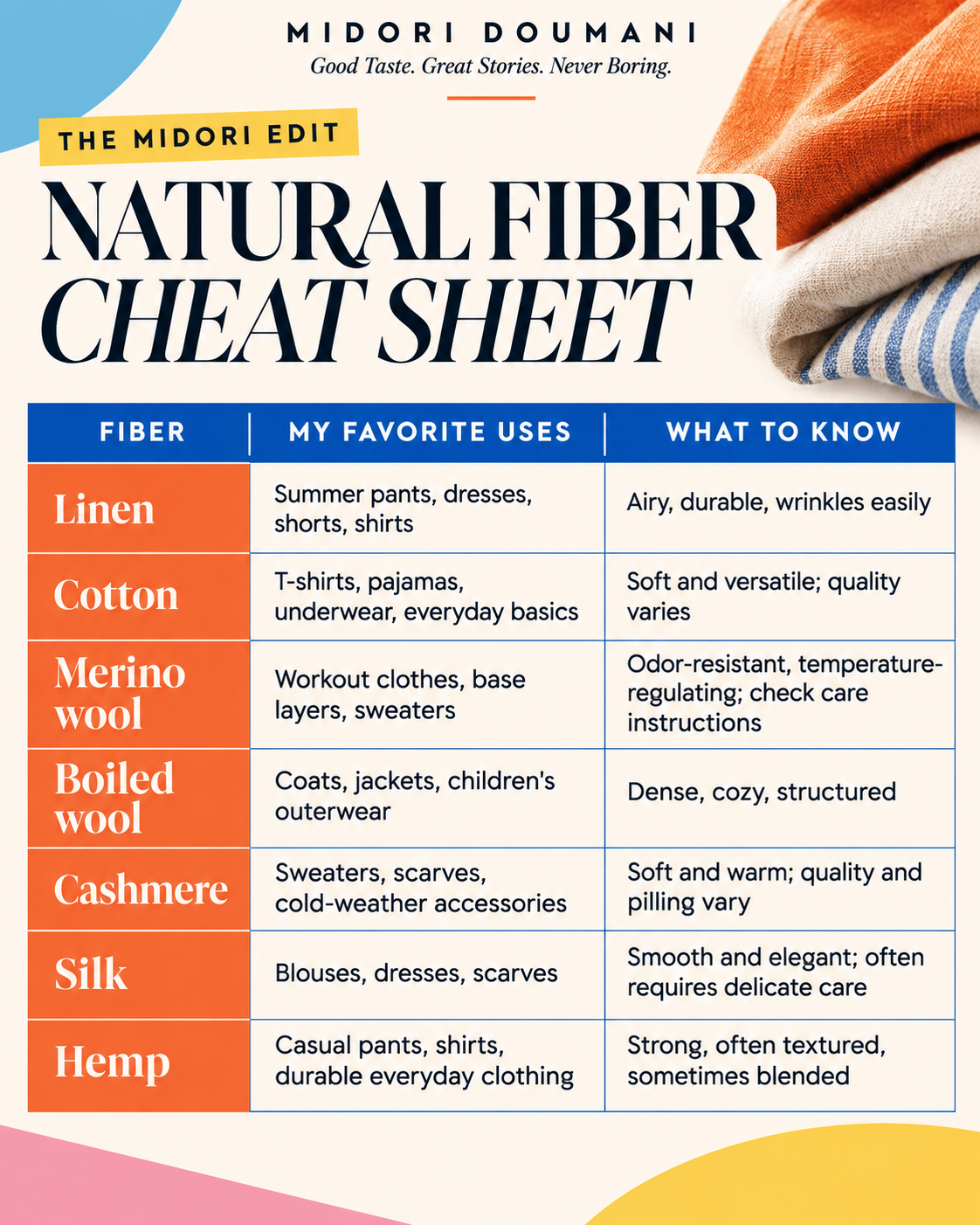
My personal starting point? Linen for warm-weather clothing, merino for versatile layers and workouts, and quality cotton for everyday basics.
That's where I've noticed some of the biggest improvements in comfort.
1. Linen: The Fabric That Started Our Obsession
If I could recommend one fabric for someone who spends time in hot weather, linen would be very high on my list.
Linen comes from the flax plant. It's strong, absorbent, relatively quick-drying, and often feels wonderfully airy, especially when the fabric is loosely woven.
It also has a beautiful texture. There's something about linen that I just love. It has personality. It looks relaxed without necessarily looking sloppy, and it can make an otherwise simple outfit feel interesting.
It's one of my favorite fabrics for summer.
After St. Barts, I understood why we kept seeing people in long linen pants and shirts. Coverage doesn't automatically equal heat. Sometimes the material and the way the garment allows air to circulate matter more than how much skin is showing.
What I love: Breathability, durability, texture, and how comfortable it feels in warm weather.
What you should know: Linen wrinkles. A lot. And although it often becomes softer with washing and wearing, some pieces can initially feel stiff.
Personally, I don't mind the wrinkles. They're part of the look. But if you want your clothes perfectly smooth all day, linen might require a little adjustment.
When shopping, I look for 100% linen, especially in summer shirts, dresses, pants, and shorts. I also check the fabric's weight and whether it's lined, because a beautiful linen dress with a polyester lining isn't quite what I'm looking for.
2. Cotton: Familiar, Comfortable, but Not All the Same
I think most of us grew up understanding that cotton was a good thing.
Cotton underwear. Cotton pajamas. Cotton T-shirts. It was always associated with comfort. And there's a reason for that.
Cotton is a plant fiber that's generally soft, absorbent, breathable, and comfortable against the skin. It's versatile enough to make everything from lightweight shirts to thick denim.
But something I didn't understand before researching fabrics is that 100% cotton doesn't automatically mean exceptional quality.
There are different varieties of cotton, different fiber lengths, and different methods of spinning, weaving, knitting, and finishing the fabric.
One of my favorites is Pima cotton.
Why I Love Pima Cotton
Pima cotton is an extra-long-staple cotton, meaning its fibers are longer than those of most conventional Upland cotton. Longer fibers can be spun into fine, strong yarns that feel wonderfully smooth.
I love that luxurious, soft feeling without needing the clothing to be overly complicated.
But I still evaluate the actual garment. A cotton label tells me what it's made from, not whether the seams are well constructed, the fabric will hold its shape, or the shirt will become misshapen after three washes.
And to clarify something: ordinary cotton is still real cotton. I just prefer better-quality cotton, particularly Pima, when I can find it.
What I love: Softness, versatility, comfort, and beautiful basics.
What you should know: Cotton absorbs moisture, but it can stay wet longer than fabrics designed to move moisture away from your skin. That's one reason I don't automatically choose cotton for every workout or outdoor activity.
For everyday shirts, pajamas, underwear, and children's clothing, though, cotton remains one of my favorites.
3. Merino Wool: The Fabric That Completely Changed My Wardrobe
Okay, I have a lot to say about wool.
Because if you think wool is only for itchy Christmas sweaters, I would love for you to reconsider.
Merino wool has become one of the most useful fabrics in my wardrobe, and not just during winter.
I work out in it. I wear it as a base layer. I wear it when it's cold. I love that I can use the same general type of fiber in so many different ways.
Merino comes from Merino sheep, whose wool is often finer than the coarse wool people associate with scratchy sweaters.
One of its most impressive qualities is how it manages moisture and temperature. Wool fibers can absorb moisture vapor, help moderate how the fabric feels against your skin, and resist developing odors.
This is a big reason I love wearing it to exercise.
For me, merino doesn't hold onto workout odors the way many synthetic clothes did. I can wear it, air it out, and often get another use before it needs washing.
Does that mean merino wool never smells? Of course not. But the difference in my experience has been remarkable.
What I love: Its versatility, odor resistance, comfort, and ability to work across different temperatures.
What you should know: Not every merino garment is created equal. Wool can shrink or felt if it's washed incorrectly, and some merino clothing contains synthetic fibers.
If you're new to wearing wool, I'd recommend reading Woolmark's guide to washing wool before putting your new sweater or base layer in the laundry.
This brings me to something I'm particularly passionate about.
Why I Look for Non-Superwash Wool
You might see wool advertised as superwash, machine washable, or easy care.
Superwash wool has been treated to reduce shrinkage and felting. Traditional treatments can involve modifying the wool fiber's outer surface and applying a resin, although processes vary.
That's convenient, especially if you want to put a sweater in the washing machine without worrying about it.
But personally, I prefer wool that hasn't undergone superwash treatment.
I like the natural properties of untreated wool, and I prefer to avoid those additional shrink-resistant treatments when possible.
This is a personal material preference, not a claim that every superwash garment is unsafe. You can read more about the different processes in Woolmark's explanation of machine-washable wool.
The tricky thing is that the regular clothing label might say "100% wool" without explaining how the fiber was processed.
So when I'm interested in a particular piece, I sometimes ask the brand directly whether the wool has been superwash-treated.
I also love vintage wool. Beautiful vintage sweaters, coats, and other wool pieces can be incredible finds. Older garments may have different constructions or treatments than modern pieces, although vintage doesn't automatically guarantee untreated wool.
Which brings us to another favorite.
Boiled Wool Deserves Its Own Moment
Boiled wool is wool fabric that has been intentionally processed with moisture, heat, and agitation to create a denser, felted texture.
It can make wonderful coats, jackets, and outerwear.
I love how substantial it feels. It's cozy, structured, and beautiful without needing to look overly polished.
For the girls, I especially love discovering wool clothing from brands such as Disana and Engel Natur.
When shopping for boiled wool, I check the wool content, lining, construction, and care instructions. I also pay attention to whether the garment is appropriate for the weather, because a dense boiled-wool coat serves a very different purpose from a lightweight merino base layer.
4. Cashmere: Beautiful, Soft, and Worth Understanding
Cashmere is one of those fabrics that people automatically associate with luxury.
And I understand why.
Good cashmere feels incredible.
It comes from the fine undercoat of cashmere goats and is prized for its softness, warmth, and relatively light weight.
I love finding beautiful cashmere pieces, especially ones with interesting colors, shapes, or details.
But here's the thing: cashmere on a label doesn't automatically mean a sweater is worth hundreds of dollars.
Quality varies. The fibers' length and fineness, the yarn, the knitting, and the garment's construction all influence how a piece wears.
Cashmere can pill, particularly where the fabric experiences friction. And delicate cashmere needs appropriate care.
I would rather find one beautiful, well-made cashmere sweater that I genuinely love than buy several disappointing ones simply because they have a luxury label attached.
I also love vintage shopping for cashmere and wool. Finding something beautiful from decades ago feels different from pulling another identical sweater off a department-store rack.
And yes, I even love the cashmere stuffed animals we've found for our girls. Chocolate + Cashmere has been one of the brands we've enjoyed exploring for cashmere pieces.
Cashmere is one of those materials where I really want to understand what I'm buying before I decide the price is justified.
5. Silk: Lightweight, Beautiful, and a Little More Delicate
Silk comes from the protein fibers produced by silkworms. It's known for its beautiful drape, smooth texture, and distinctive sheen. Depending on how it's woven, it can look glossy and elegant or soft and understated.
I think silk is especially lovely for blouses, dresses, scarves, and certain sleepwear pieces.
But silk requires attention.
Some silk garments can be hand-washed, while others require professional cleaning. The fabric may also be sensitive to abrasion, sunlight, and certain products.
I would always read the care instructions before buying a piece.
Also, don't confuse something that feels silky with something that's actually silk.
Polyester satin can have a similar glossy appearance. Satin describes a type of weave, not necessarily a fiber.
So if you're looking for silk, check the tag.
6. Hemp: Another Natural Fiber Worth Knowing
Hemp comes from the stalk of the hemp plant and can be used to make strong, durable textiles.
It often has a slightly rustic feel, although that depends on how it's processed and constructed.
Hemp is sometimes blended with cotton to soften the fabric and change its texture.
It's worth exploring if you enjoy the appearance of linen and are interested in durable plant-based clothing.
I don't reach for hemp as often as linen, cotton, or wool, but I think it deserves a place in a beginner's natural-fiber guide.
What About Polyester, Acrylic, and Nylon?
This is where our family's approach to shopping becomes more particular.
We no longer intentionally buy clothing made from polyester, acrylic, nylon, or elastane blends.
But I want to explain what those fabrics actually are, because I think it's important to understand them before deciding what works for you.
Polyester is a synthetic fiber, most commonly made from polyethylene terephthalate (PET). It's used in everything from athletic wear to dresses, coats, and furniture fabrics. It can be durable, wrinkle-resistant, and quick-drying, but comfort varies considerably depending on the fabric.
Acrylic is another synthetic fiber often used in sweaters, blankets, and items designed to mimic wool. It can be soft and inexpensive, but I personally prefer real wool.
Nylon, also called polyamide, is commonly used in tights, activewear, underwear, outerwear, and other clothing where strength or stretch is useful.
Elastane, also known as spandex or Lycra, adds stretch. That's why you'll frequently see clothing labeled 95% cotton and 5% elastane, or a similar blend.
Some of these fabrics have genuine performance advantages. I'm not pretending they don't.
I simply prefer the way natural fibers feel and perform in our daily lives, and avoiding petroleum-based synthetic fibers is now part of how our household shops.
What About Microplastics and Chemicals in Clothing?
When we first started researching synthetic clothing, we read about microplastic shedding, textile finishes, dyes, and potential chemical exposures.
There's legitimate research here, but I think it's important to separate what we know from what we're still learning.
Synthetic clothing can release tiny plastic fibers during washing and wear. This is an established environmental concern.
Certain chemicals used in textile production or finishing also raise health and environmental questions. These may include some dyes, water-repellent treatments, plasticizers, and other substances.
However, a garment being polyester doesn't automatically establish that wearing it will disrupt your hormones. And a garment being natural doesn't automatically mean it's chemical-free or harmless.
Cotton, wool, linen, and silk can also be dyed, bleached, finished, or otherwise chemically treated.
For me, learning about all of this created a desire to become more intentional about what I purchased. I started paying attention not just to the fiber, but also to how clothing was made and treated.
That's still a learning process. And I think it's completely reasonable for someone else to look at the same information and make different purchasing decisions.
How to Read Clothing Labels Without Getting Overwhelmed
You don't need a degree in textile science to begin shopping more intentionally.
You just need to start turning clothes inside out.
Seriously.
The next time you're shopping, before you become attached to how something looks or how much you love the color, find the label that lists the fabric composition.
Here's what I pay attention to:
1. The fiber percentages. A sweater labeled 80% acrylic and 20% wool isn't the same as a 100% wool sweater, even if both are marketed as cozy winter knitwear.
2. The entire garment. Check the lining, outer fabric, and separate material details when available. A beautiful wool coat might have a polyester lining.
3. Fabric treatments. If something is advertised as stain-resistant, wrinkle-free, waterproof, or machine-washable wool, I sometimes investigate how it achieves those properties.
4. The care instructions. I want to know whether I'm buying something I can realistically maintain. If it's delicate, that's fine, but I'd rather know before checkout.
5. How the fabric actually feels and moves. The label is important, but so is the weight, construction, fit, and texture of the garment.
In the United States, most textile and wool products must disclose fiber content on their labels. So if something is correctly labeled 100% cotton, it should actually be cotton. But that still leaves plenty of room for differences in quality.
I've also learned that brands can change the materials they use between products and seasons.
So even if I love a particular brand, I still check the individual garment.
Brands and Pieces We've Enjoyed
One unexpected benefit of changing our shopping habits is that we discovered so many interesting brands we'd never paid attention to before.
Here are some that have become part of our natural-fiber shopping journey.
Merino.tech has been one of our places to look for merino clothing, particularly practical everyday pieces and base layers. I love how versatile merino is, especially for working out and layering.
Cottonique is another brand we've enjoyed for cotton clothing and basics. Its focus on cotton and material-sensitive shoppers makes it worth exploring.
For the girls, I love Disana and Engel Natur, particularly their wool clothing and beautiful cold-weather pieces.
I also enjoy Dr. Collectors, RRL, and vintage shopping, especially for interesting wool, cotton, and other pieces with character.
And if you enjoy distinctive clothing, take a look at iKKim'O. I love discovering brands that offer something different from the same things you see everywhere else.
Chocolate + Cashmere is another name we've enjoyed, particularly for beautiful cashmere items.
Outside of clothing, we've also enjoyed Softstar Shoes for their barefoot-style footwear. Shoes are a different conversation from clothing fibers, of course, but footwear materials became another thing we started thinking about more intentionally.
These are brands and places we've personally gravitated toward, not a guarantee that every item they sell meets our standards. Some brands offer blends, and materials can vary from one product to another.
I still read the label before buying.
Does Natural Fiber Clothing Have to Be Expensive?
No. But beautiful, well-made natural-fiber clothing can be expensive.
I think this is where people get discouraged. You start reading clothing labels and realize the $40 sweater you were about to buy is acrylic. Then you find a beautiful wool sweater that costs $200 and wonder if changing your wardrobe means spending a fortune.
It doesn't have to.
One of my favorite things about vintage shopping is that you can find incredibly interesting pieces, often made with beautiful materials, without paying contemporary designer prices.
And not every garment needs to be cashmere or Pima cotton.
A well-made, ordinary cotton T-shirt can be wonderful. A simple linen shirt can become something you wear constantly.
But I do believe in paying more when the quality, fit, construction, and longevity justify it.
What I no longer want to do is spend a premium price simply because something has an expensive brand name.
We did plenty of that before.
I've realized that a beautiful label on the outside of a garment doesn't tell me nearly as much as the little label sewn inside.
Do You Need to Throw Away Your Entire Wardrobe?
No.
And I know that's funny coming from someone whose family practically did.
Our decision to donate so much clothing happened after we'd spent time researching, discussing what we wanted, and deciding what mattered to us.
I don't think everyone needs to take that approach.
In fact, if you already own clothing that's comfortable, functional, and in good condition, continuing to use it can be a perfectly reasonable choice. Throwing away synthetic clothing doesn't make the material disappear, and donating it doesn't necessarily guarantee that it will be reused.
If you're just beginning, I'd start much smaller.
Maybe your next summer purchase is a linen shirt instead of a polyester one.
Maybe you try a merino wool workout top and see how you feel about it.
Maybe you start checking the material composition of expensive clothing before deciding whether the price is justified.
You can make changes gradually as things wear out or as your needs change.
I also wouldn't suggest replacing everything before you've had a chance to try these materials. Wool may feel wonderful to me, but you might prefer cotton. You might love linen's texture and absolutely hate the wrinkles.
That's okay.
The point is to make informed decisions about what works for your life.
Frequently Asked Questions About Natural Fiber Clothing
Is TENCEL a natural fiber?
Not technically. TENCEL is a brand used for certain manufactured cellulosic fibers, such as lyocell and modal, which are derived from plant-based cellulose. They're different from natural fibers like cotton and linen, but they're also different from petroleum-based synthetic fibers like polyester.
Is merino wool only for winter?
No, and that's one of my favorite things about it. Lightweight merino can work well for travel, exercise, and transitional weather. The thickness, construction, and fit of the garment matter, so I wouldn't treat every wool sweater as a summer option.
Is 100% cotton always better than polyester?
Not necessarily. They have different properties and uses. I personally prefer cotton for many everyday pieces, but a polyester performance shirt might be better suited to certain activities. And even among 100% cotton garments, quality can vary substantially.
How do I know if wool is superwash?
Sometimes the manufacturer will say, but a label reading "100% wool" doesn't necessarily answer the question. If untreated wool matters to you, ask the brand whether the garment uses superwash or another shrink-resistant treatment.
Are natural fibers automatically sustainable?
No. The environmental impact of clothing depends on more than fiber content. Farming and animal husbandry, processing, dyeing, transport, durability, how frequently you wear the garment, and what happens to it afterward all matter.
One Last Thing: Natural Doesn't Automatically Mean Better
I love natural fibers. Our family has made a significant commitment to wearing them, and we have no plans to return to our old shopping habits.
But I don't think you should buy something simply because the label says natural.
A poorly made linen shirt is still a poorly made shirt.
An uncomfortable wool sweater is still uncomfortable.
A cashmere sweater that pills terribly after a few wears isn't automatically a fantastic purchase because it's cashmere.
And a natural-fiber garment can still involve environmentally intensive production processes, chemical treatments, or poor labor practices.
The material is one part of the decision.
What I want is clothing that feels good, performs well, is made thoughtfully, and lasts.
I also want to understand what I'm paying for.
The Little Label I Used to Ignore
It's funny to think that all of this started because Joshua was sweating in St. Barts.
We were on vacation. I wasn't looking for a new wardrobe philosophy or planning to come home and donate an enormous amount of clothing.
I just wanted my husband to stop complaining about how hot he was.
And then I touched his back.
That one moment led us into a whole world of learning about natural fibers, clothing construction, fabric treatments, and why two outfits that look almost identical can feel completely different.
Now I can't shop the way I used to.
I still love beautiful clothes. I love interesting colors, thoughtful design, incredible vintage finds, and pieces that make getting dressed fun.
Probably even more than before.
But I want to know what's underneath all that beauty.
So the next time you find something you absolutely love, turn it inside out and check the tag.
You might be surprised by what you find.
I certainly was.
And if you have a natural-fiber brand you absolutely love, please tell me. I'm always looking for beautiful things made from beautiful materials.
Especially if someone knows where to find incredible vintage wool.
I'm listening.
— Midori
